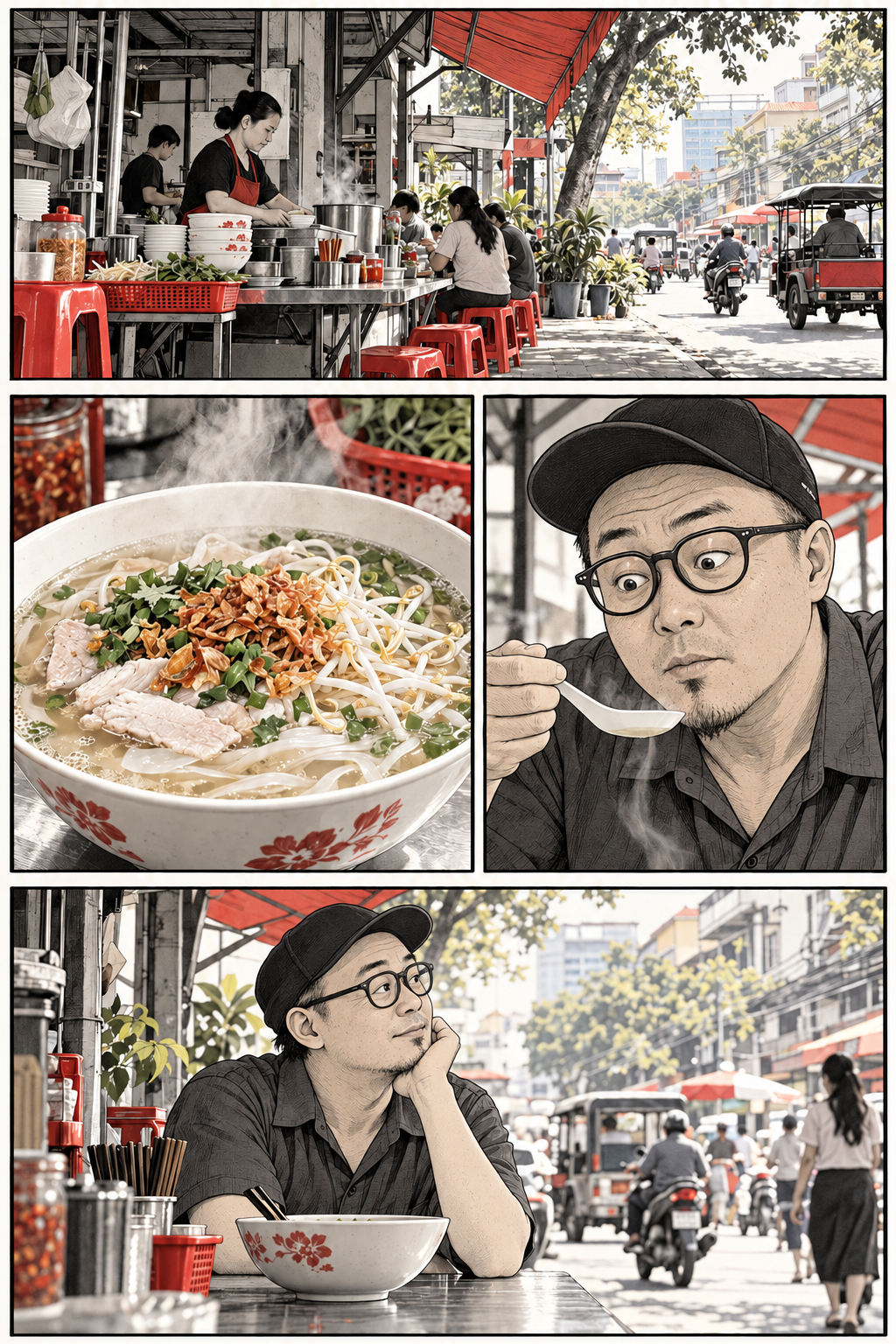
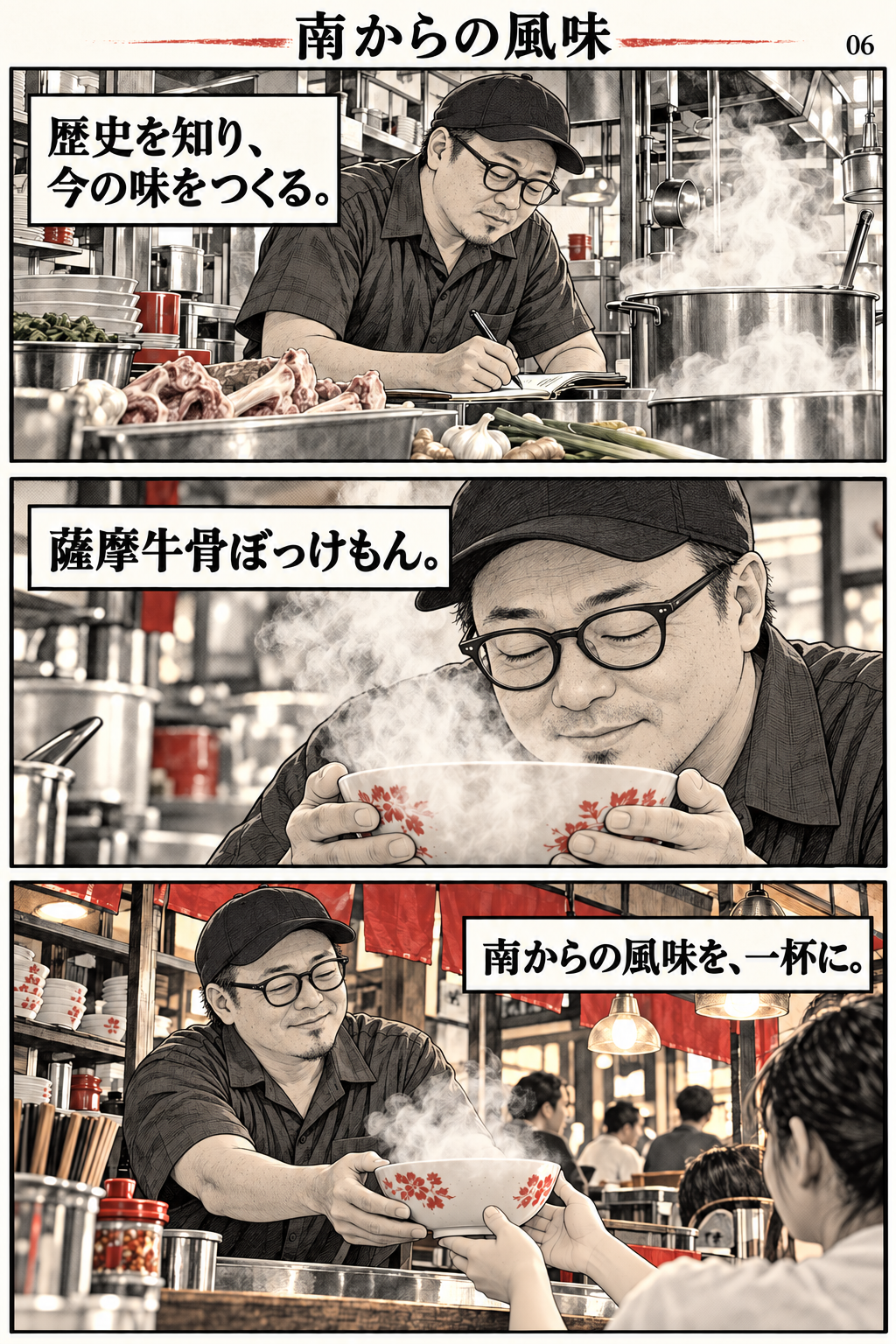
Illustrated manga about the inspiration for this product. Characters and dishes are artistic interpretations.
Satsuma Gyukotsu BokkemonComing first to Menya Aburaya, Tenmonkan Main Store
Where this bowl begins
A beef-bone specialist’s vision in a bowl.
Drawing on our beef-bone broth expertise, we give flavor to an imagined origin.
Menya Aburaya was already a beef-bone ramen specialist. Years of working with beef bones and developing broth-making skills form the foundation of Satsuma Gyukotsu Bokkemon.
The sense of familiarity we found between Cambodian noodle dishes and Kagoshima ramen prompted us to look at our own bowl through the history of food culture.
Ramen made with pork and chicken developed in Kagoshima. People use what is available locally and create a local taste. Thinking about that background led us to imagine one possibility.
With pig and poultry farming so well established in Kagoshima, perhaps pork bones and chicken carcasses were readily available—and the least expensive broth ingredients—when ramen spread locally. We think this may have been one reason they were chosen.
Meanwhile, some Southeast Asian noodle dishes use beef-bone broth. Vietnamese beef pho, for example, combines rice noodles with broth simmered from beef bones, meat, and herbs. As specialists who already worked with beef bones, we were drawn to the possible connections between these southern soups and Kagoshima’s flavors.
What if noodle culture changed to suit locally available ingredients as it crossed the sea? Perhaps beef-bone soup was part of an earlier food landscape that preceded Kagoshima’s bowl.
“Could beef-bone soup have been part of Kagoshima ramen’s roots?” As beef-bone specialists, we can turn that possibility into flavor.
With the beef-bone broth skills we have developed, Aburaya creates a new bowl that imagines a connection between Kagoshima and places across the sea. Satsuma Gyukotsu Bokkemon combines specialist craft with historical imagination. Here, “re-creation” means a flavor inspired by possible origins, not the reconstruction of an old recipe established by historical evidence.
A discovery in Cambodia
Something felt familiar. We wanted to know why.
Kuyteav is a beloved Cambodian noodle dish. Through the steam, something about it reminded us of ramen back in Kagoshima.
Bean sprouts, green onions, and fragrant fried garlic. There are familiar elements, but the noodles, flavors, and local histories are different.
“Where does this familiarity come from?” That question became the starting point for developing this product.
Hospitality at the table
Before the bowl, a small side dish.
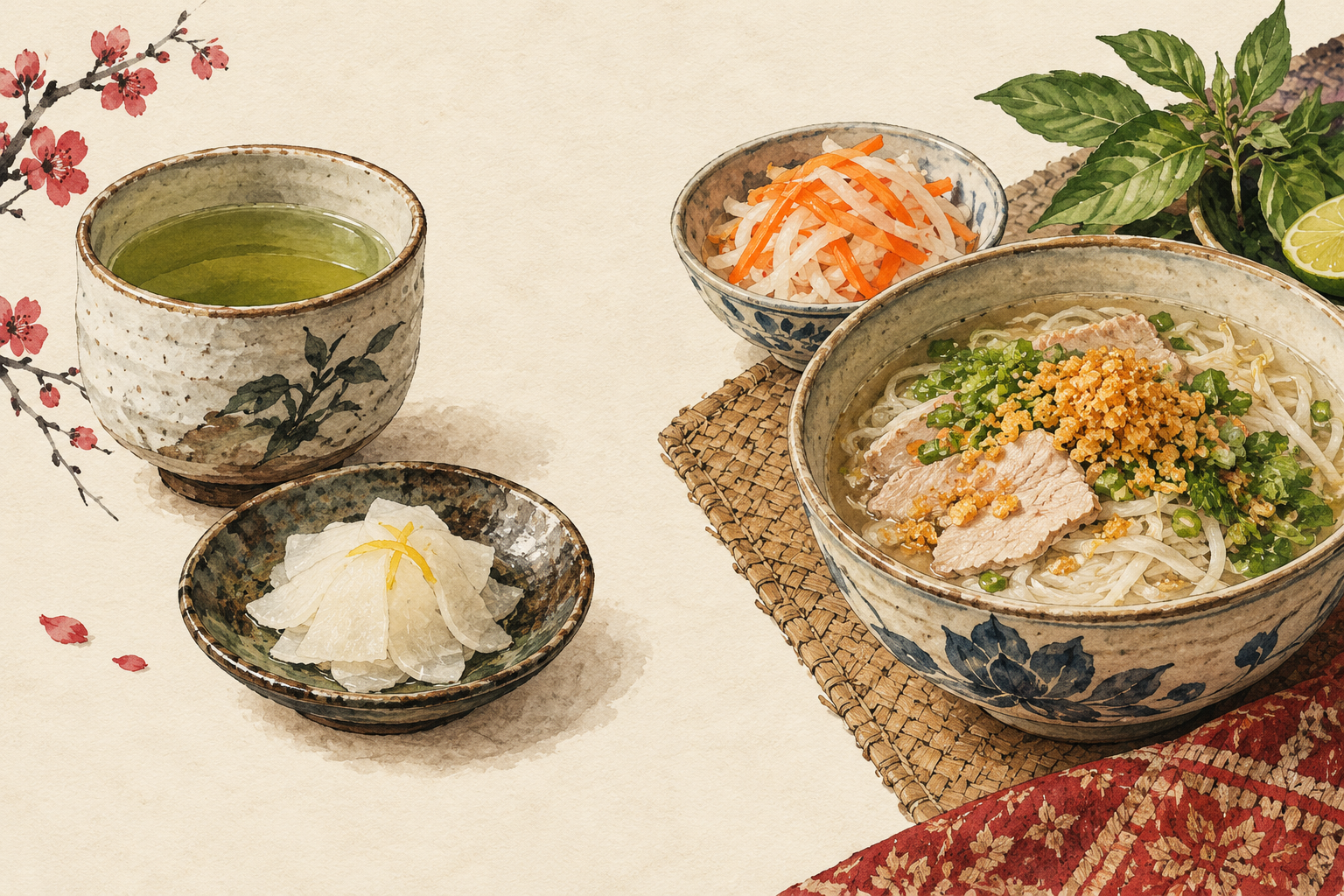
AI-generated illustration of similarities at the table. Plating is illustrative.
Kagoshima food culture
Pickled daikon and “cha ippe.”
Tea and pickled daikon while waiting for ramen: this small dish is an important part of Kagoshima’s ramen culture. Service varies by shop, but local thoughtfulness can be felt even before the noodles arrive.
“Cha ippe” is a Kagoshima expression inviting someone to have tea and take a break. In an MBC report, historian Izumi Haraguchi described serving tea and pickles to guests as a traditional form of Satsuma hospitality.
There are several explanations for how complimentary pickles began in ramen shops. Cha ippe has not been established as the sole origin.
Sources 5–6 ↗Food comparison: the developer’s perspective
A familiar welcome in chrouk, too.
The kuyteav we have eaten in Cambodia has always come with a small plate of pickles. We nibble sweet-and-sour daikon and carrot between mouthfuls of noodles. That meal, extending beyond the bowl itself, reminded us of Kagoshima ramen and its pickled daikon.
In these small plates of pickles, which we call chrouk, we also sense the care of welcoming someone. Kagoshima’s cha ippe and Cambodia’s tables with pickles differ in flavor and custom, but we feel a familiar concern for the person eating.
The pairing of kuyteav and pickles comes from the developer’s personal experience. It is not a claim about every shop in Cambodia or any region. The comparison with cha ippe reflects the hospitality we personally perceive.
Fried garlic adds a toasted fragrance to kuyteav. Finely chopped garlic is fried and used as a condiment, layering its aroma with the freshness of green onions. Condiment combinations vary by shop and dish.
Southern Fujian and Chaozhou maritime merchants in southern Kyushu
Merchants based around Zhangzhou Bay in southern Fujian expanded their activities through Ryukyu to Tanegashima and southern Kyushu. Merchants from neighboring Chaozhou in eastern Guangdong followed, connecting southern Kyushu to coastal Chinese trade networks, according to research by Gakusho Nakajima.
Chinese ships arrive at Konejime in southern Kyushu
In 1544, Chinese ships arrived in succession at Konejime port in Osumi. Maritime merchants, including those engaged in illicit trade, connected southern Kyushu with a wider maritime world. These records do not directly document the importation of dishes.
Accounts include their arrival on Tanegashima and Maeda Riemon bringing them to Yamagawa. The introduction of an ingredient is considered separately from the introduction of a confectionery technique.
Satsuma’s southern and illicit trade in the late Edo period
During the time of Zusho Hirosato and Shimazu Nariakira, Satsuma engaged in illicit trade with southern regions despite shogunate controls. This belongs to a different period from the maritime merchant activity of the 16th century.
As Teochew people from southern China migrated to Southeast Asia, rice-noodle food cultures spread too. The name of southern Chinese guotiao, known in Teochew as kway teow, is connected with Cambodia’s kuyteav and Vietnam’s hu tieu. Soups and toppings changed locally, creating distinct regional flavors.
The shop began with its proprietress, a Taiwanese craftsman named Wang, and others. Its official history says the first proprietor drew on nutrition and used cabbage to consider nutritional balance.
Satsuma Gyukotsu Bokkemon is planned for an initial launch at Aburaya’s Tenmonkan Main Store. The launch date is not yet set. Interest in history and discoveries at the table inspire today’s flavor-making.
Historical trade is documented. However, the sources we have checked do not establish a direct lineage in which kuyteav passed through Ryukyu or Satsuma and became Kagoshima ramen. This product is a contemporary creation inspired by history.
The people behind the flavors
From person to person. A bowl that grew in Kagoshima.
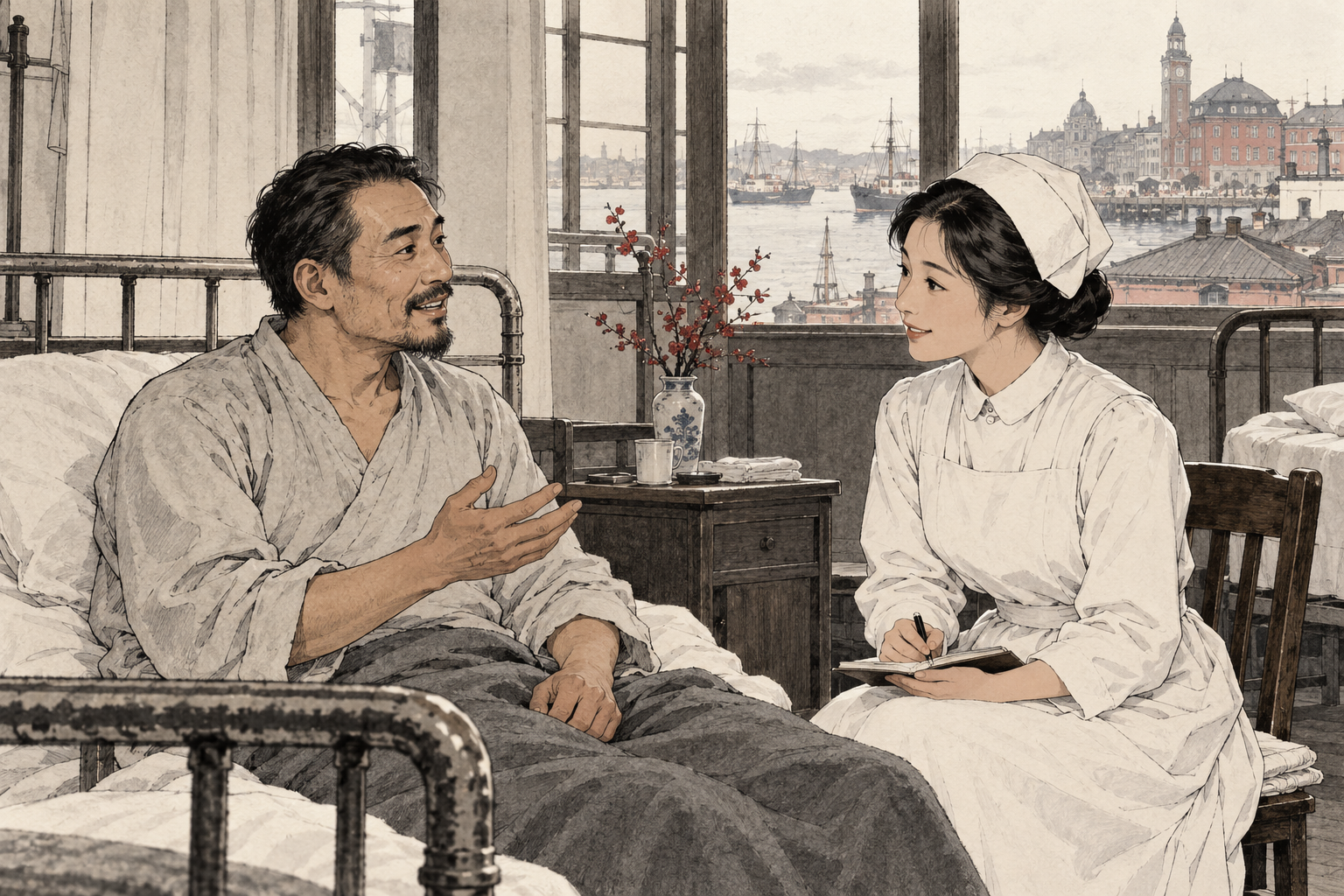
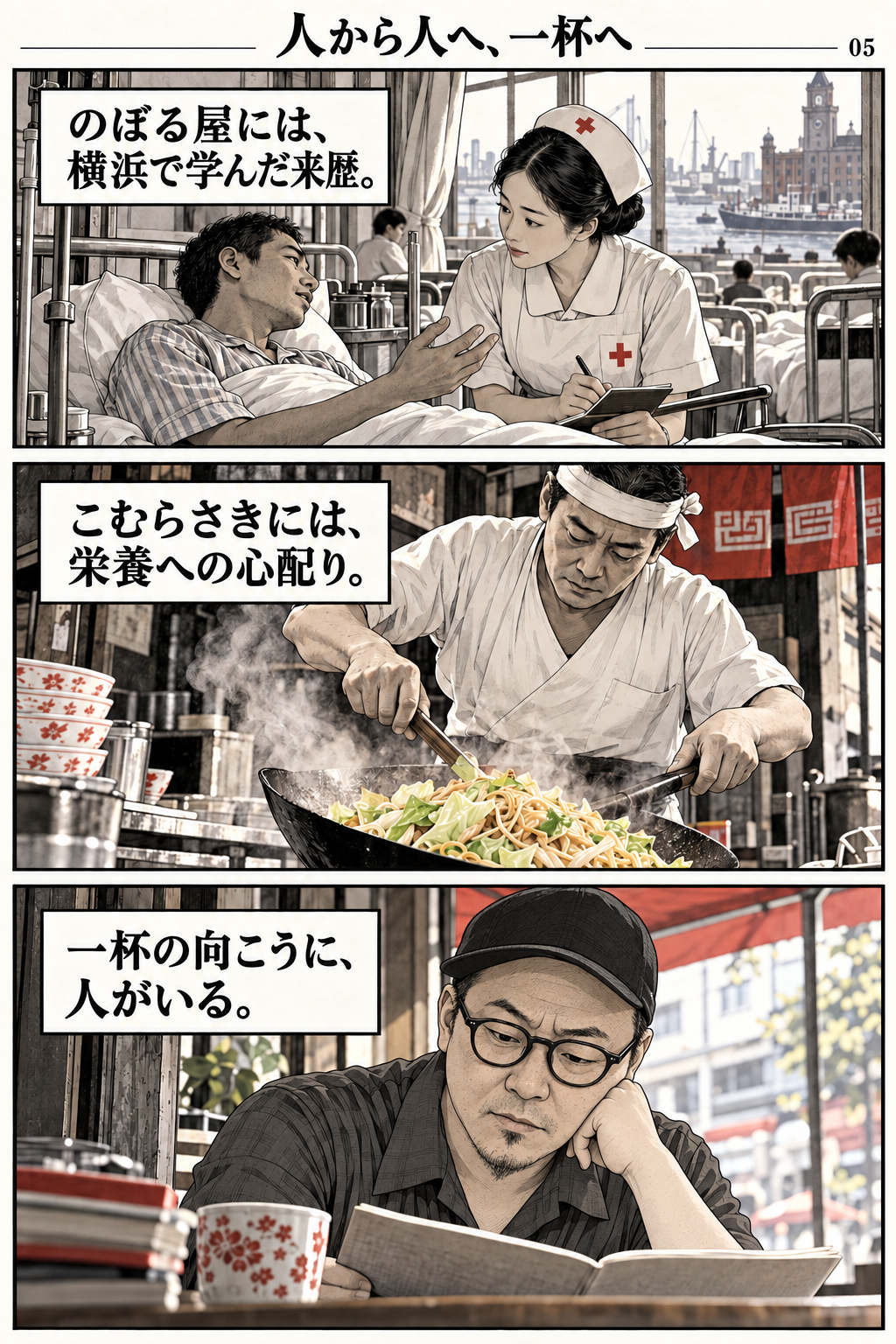
AI-generated illustration inspired by Noboruya’s story. The faces, hospital room, and conversation are imagined, not archival photography or a precise reconstruction.An account preserved in later sources
Noboruya: a story connected to a Yokohama hospital.
Tsuna Michioka was Noboruya’s female founder. According to the Shin-Yokohama Ramen Museum and KBC, while working as a nurse in Yokohama, she learned to make soup from a Chinese cook who was a patient in the hospital.
An encounter through nursing led to flavor-making in Kagoshima. This is the human story told about the shop that opened in 1947.
This account comes from later reporting and commentary, not a contemporary personal record we have verified. It does not identify one shop as the sole origin of all Kagoshima ramen.
According to its official history, Kagoshima’s Komurasaki was founded in 1950. It began with the proprietress, a Taiwanese ramen craftsman named Wang, and a young female relative. Wang later married the proprietress and developed the shop’s flavor as its first proprietor.
The official history says he incorporated nutritional thinking from the early days, using plenty of cabbage for balance. It also explains that avoiding excessive carbohydrate intake was a reason for not serving rice.
This shows an approach to ramen as a meal that considers nourishment, rather than simply a snack to fill a small hunger. It offers a specific example for viewing Kagoshima ramen as nourishing food.
This does not mean every Kagoshima shop began with the same philosophy. “Nourishing food” is a perspective on this shop’s history, not a claim of medical benefits or a nutritional guarantee for our product.
Rice noodles begin their journey with southern China’s “guotiao.”
People who moved from southern China to Southeast Asia developed food cultures through trade and everyday life. Fujian and Chaozhou are neighboring areas, but their regions and languages have distinct characteristics.
The rice noodles that preceded kuyteav are called “guotiao (粿條)” in southern China. Particularly popular in Chaozhou and the Chaoshan area of Guangdong, they are flat noodles made from rice. Their Teochew name is romanized as kway teow, a name connected with Cambodia’s kuyteav and Vietnam’s hu tieu. Migrants sold noodles, shared tables, and cooked with local ingredients. We distinguish these southern Chinese rice-noodle roots from the question of whether today’s kuyteav broth and toppings were transmitted unchanged from China.
In Vietnam’s hu tieu Nam Vang, Nam Vang means Phnom Penh. MICHELIN Guide describes a history in which Teochew noodle sellers established themselves in Cambodia before the dish traveled to Vietnam. Food moved with people and changed along the way.
As ingredients and seasonings change, dishes become local. We see a familiar reflection of Kagoshima’s varied bowls in that process.
Satsuma, Fujian, and Chaozhou: maritime links, including illicit trade.
Research on the 16th century describes maritime merchants from Zhangzhou in southern Fujian and Chaozhou in eastern Guangdong expanding their activity to Ryukyu and southern Kyushu. Zhangzhou in Fujian and Chaozhou in Guangdong are different places.
Late-Edo Satsuma also has a history of southern and illicit trade. These links provide context for thinking about food culture, but they do not establish that kuyteav or particular sweets were carried to Satsuma on those ships.
Akumaki is a Kagoshima sweet made by soaking glutinous rice in lye, wrapping it in bamboo skin, and boiling it. Lye gives it a distinctive color and chewy texture. Similar rice dumplings exist in China, and one account says the technique arrived through Japanese missions to Tang China. This is a tradition described by Japan’s agriculture ministry and others, not a confirmed route of introduction.
We distinguish traditions about origins from documented cooking methods. Not all Cambodian wrapped sweets use lye, and a direct lineage with akumaki has not been established.
Kagoshima’s tsukeage, known throughout Japan as satsuma-age, is made by seasoning minced fish, shaping it, and deep-frying it. Okinawa’s chikiagi is described as its predecessor. In Okinawa, too, fish paste is fried, with varieties incorporating vegetables, seaweed, and other ingredients.
Cambodia also has a fried fish-paste dish called Prahat Chien. Describing it to Japanese visitors as “Cambodian satsuma-age” may convey the familiarity we felt at the table.
Mincing fish, seasoning it, and frying it: placing these dishes from Kagoshima, Okinawa, and Cambodia side by side highlights their shared handwork.
The account of chikiagi as a predecessor of satsuma-age comes from Japan’s agriculture ministry. Our comparison with Prahat Chien concerns culinary similarities, not a confirmed direct route of transmission among all three dishes.
Gane is a Kagoshima dish of shredded sweet potato and vegetables bound in batter and fried, a kind of sweet-potato kakiage fritter. Its shape resembles a crab, called gane in the local dialect. Mildly sweet, it can be eaten as a side dish or a snack.
Cambodia has a fried taro dish called Trav Chhean (ត្រាវចៀន). Kagoshima’s gane uses sweet potato; trav chhean uses taro. Although the tubers differ, fried tubers evoke a familiar taste of home for us. Alongside noodles and pickles, these fried dishes are another food-culture similarity explored by this project.
The dish name and Khmer spelling were confirmed by the developer. We are describing a shared idea of frying tubers, not claiming identical ingredients or techniques. Direct historical transmission between these dishes has not been established.
Looking at Kagoshima’s sweet-potato confections draws our attention to Cambodian sweets made with tubers. A local restaurant’s official menu lists desserts combining sweet potato with sesame or coconut.
Both turn familiar tubers into something sweet, but their methods are not necessarily the same as Kagoshima’s. This project enjoys both the shared ingredients and the differences in flavor.
SatsumaKagoshima·RyukyuOkinawa·ChinaMaritime exchange·Southeast AsiaInspiration in Cambodia
Places explored in this story. This is not a diagram of noodle transmission routes.
Manga
A small journey, beginning with a bowl.
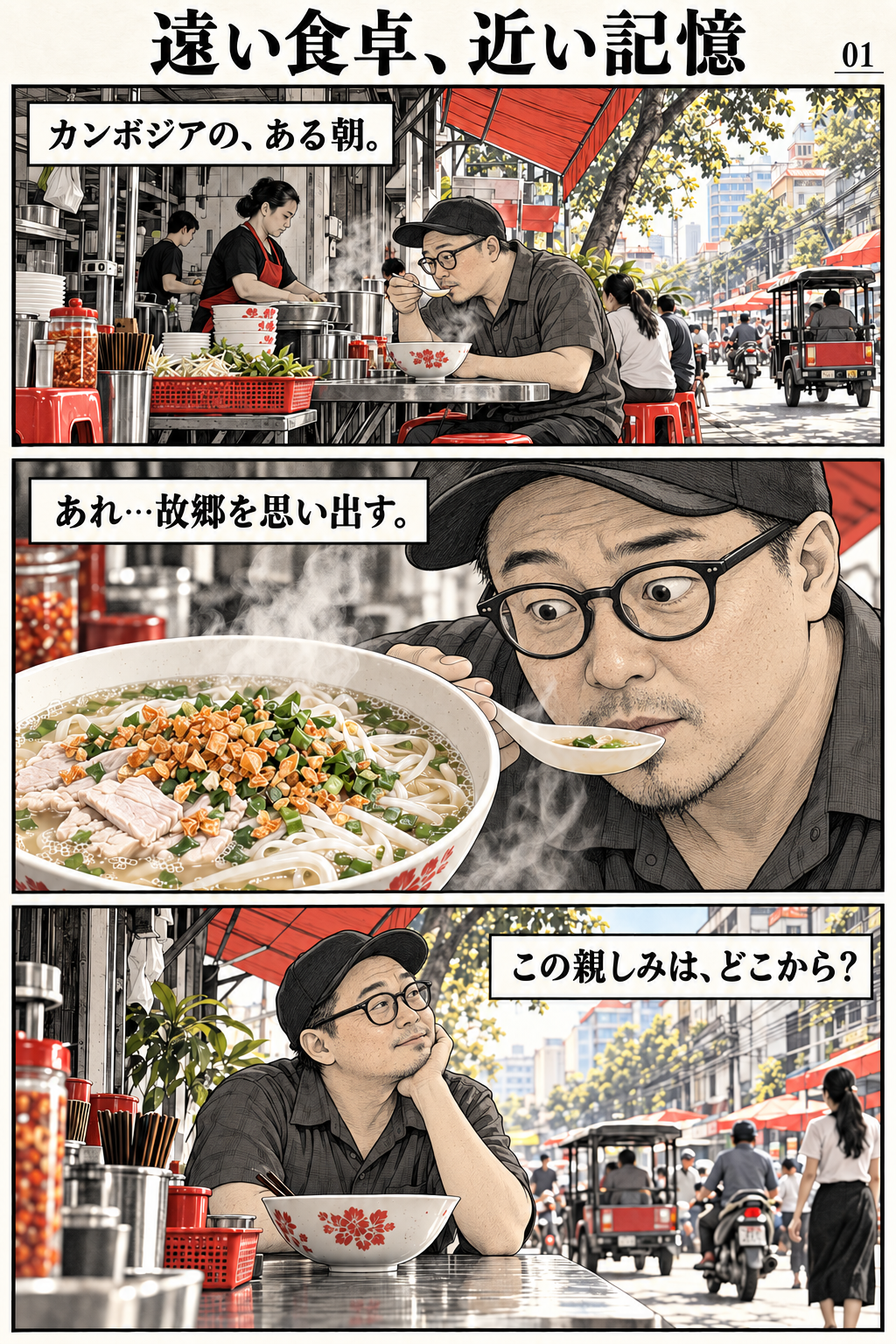
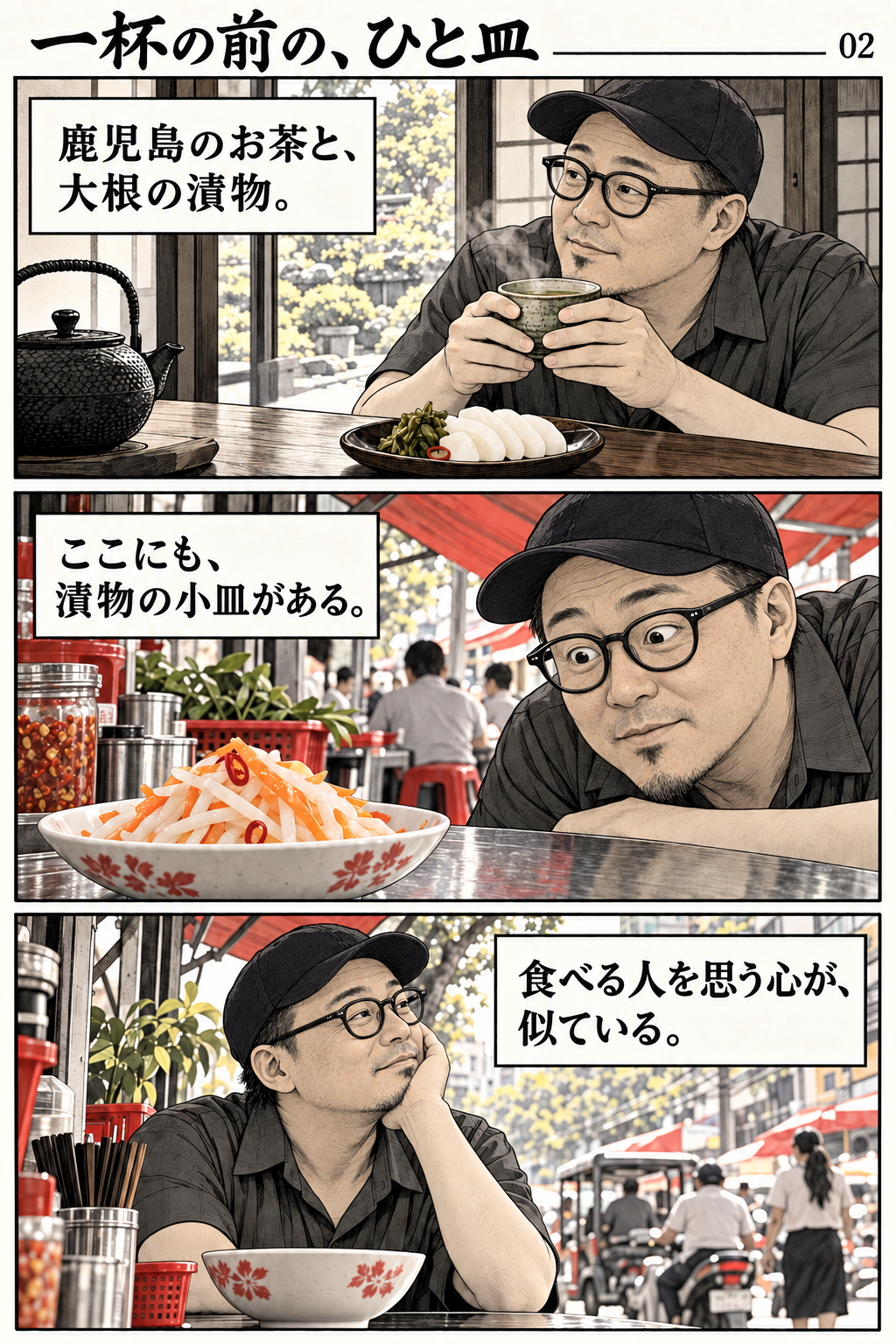
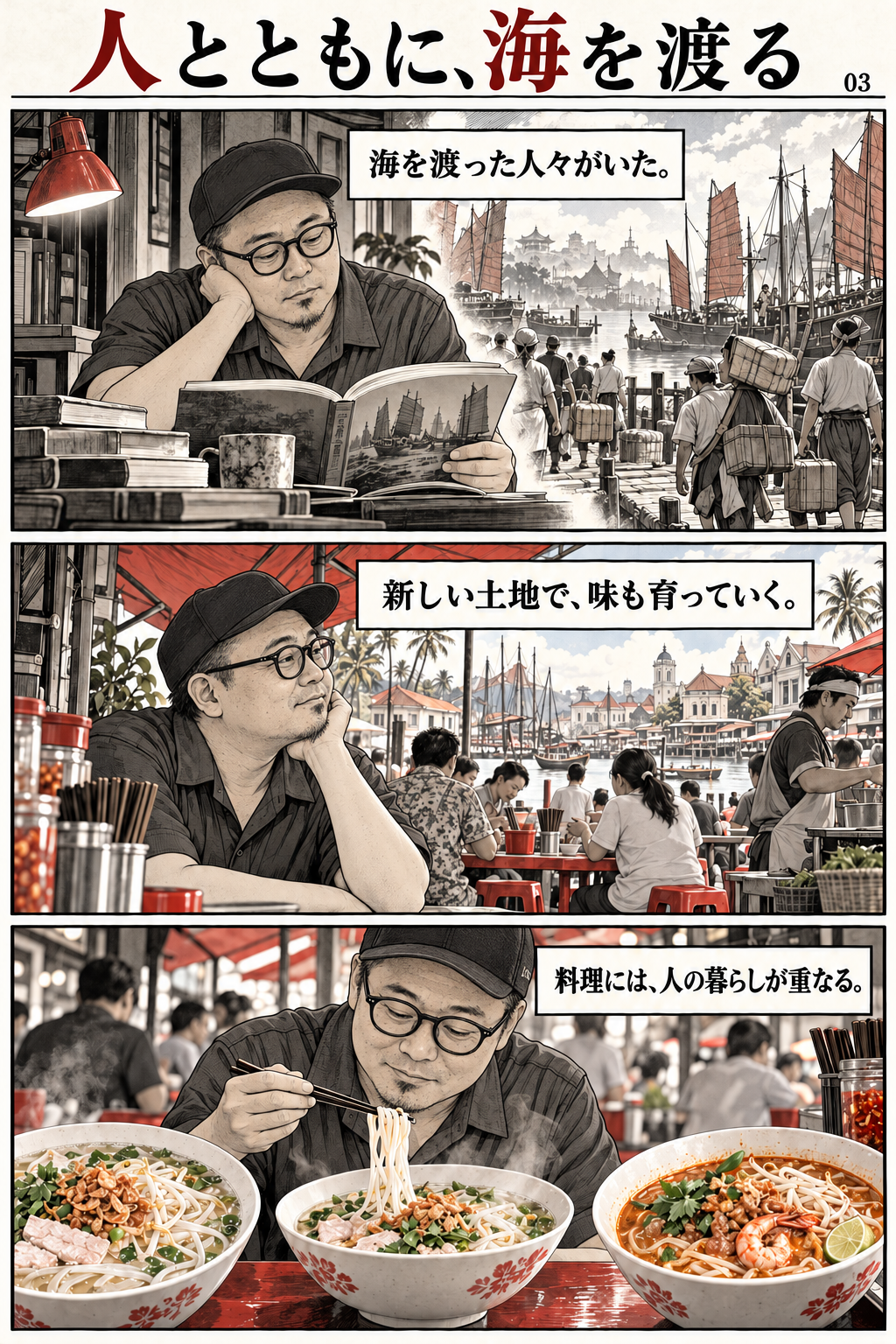
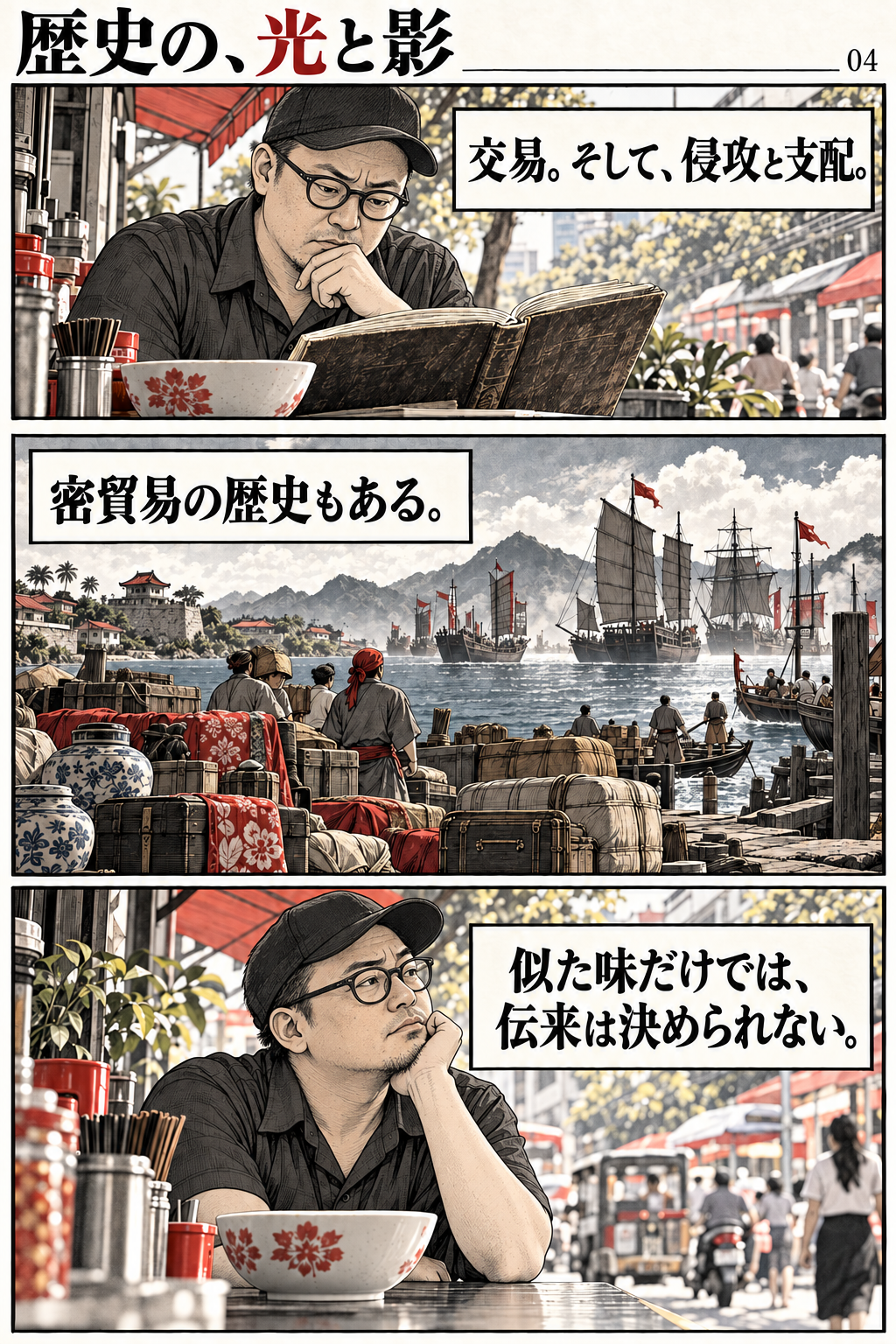
A six-page manga in a mature, grounded style. Scroll down to read all six pages in sequence. The protagonist is based on a supplied photograph. Dialogue and scenes include artistic interpretation. See the main text’s references for historical information. The artwork is in Japanese; translated dialogue appears below each page.
Page 1 of 6
A distant table, a familiar memory
Translated dialogue — page 1
One morning in Cambodia.
Wait… this reminds me of home.
Where does this familiarity come from?
Page 2 of 6
A small dish before the bowl
Translated dialogue — page 2
Kagoshima’s tea and pickled daikon.
There is a small plate of pickles here, too.
The thoughtfulness toward the diner feels familiar.
Page 3 of 6
Across the sea, with people
Translated dialogue — page 3
People crossed the sea.
Flavors grew in new places, too.
Food carries people’s everyday lives.
Page 4 of 6
History’s light and shadow
Translated dialogue — page 4
Trade. And invasion and rule.
There is a history of illicit trade, too.
Similar tastes alone cannot establish transmission.
A creative re-creation made possible by beef-bone specialists. With the beef-bone broth skills we have developed, we imagine: “Could beef-bone soup have been part of Kagoshima ramen’s roots?” And we give that possibility flavor in a bowl. Read the inspiration behind this bowl ↑
Launch date
To be announced
Available at
Menya Aburaya, Tenmonkan Main Store
Price (tax included)
¥900
Broth and toppings: beef-bone broth, bean sprouts, green onions, fried garlic, fried burdock, and chashu. Product photos, detailed ingredients, allergen information, and serving conditions will be added after confirmation. Please check with the shop before ordering if you have dietary requirements.
Looking ahead to “Nanpo Fukuro.”
The product will launch first under the Aburaya name. Later, we plan to rename the restaurant Nanpo Fukuro, continuing to share Flavors from the South. We will announce the timing once it is decided.
References
Sources alongside the story.
Sources checked: November 1, 2026. These include official and specialist explanations, a shop’s official history, journalism, and culinary materials. They are not primary evidence establishing a direct transmission route for noodle dishes. Linked materials and downloadable editorial documents may be in their original languages.